
I sought the LORD, and He answered me and rescued me from all my fears. Those who look to Him are radiant with joy; their faces will never be ashamed.
Psalm 34:4-5
by
Elizabeth
 Sep 25, 2026
Quick Answer: Your accountant asks for information because bank transactions don’t tell the whole story. Receipts, statements, and your explanations help us record things correctly, check for missing details, and finish reports you can use. Even when we handle your monthly accounting, we still need you to explain what happened in your business.
You sent the bank statements. You uploaded the receipts. Then another email lands in your inbox asking what a payment was for. Didn’t you hire an accountant so you wouldn’t have to deal with all of this?
We understand the frustration. You have customers to help, employees with questions, and plenty of other things waiting on you. Answering questions about last month’s (or last year’s) purchases probably isn’t at the top of your list.
If you’ve raised small kids, you know the stage — the one where they ask about twenty gagillion questions in a row. Sometimes accountants can sound the same way. We promise we’re not trying to get on your nerves. We’re trying to make sure we have the right information before it lands on your books, or worse, your tax return.
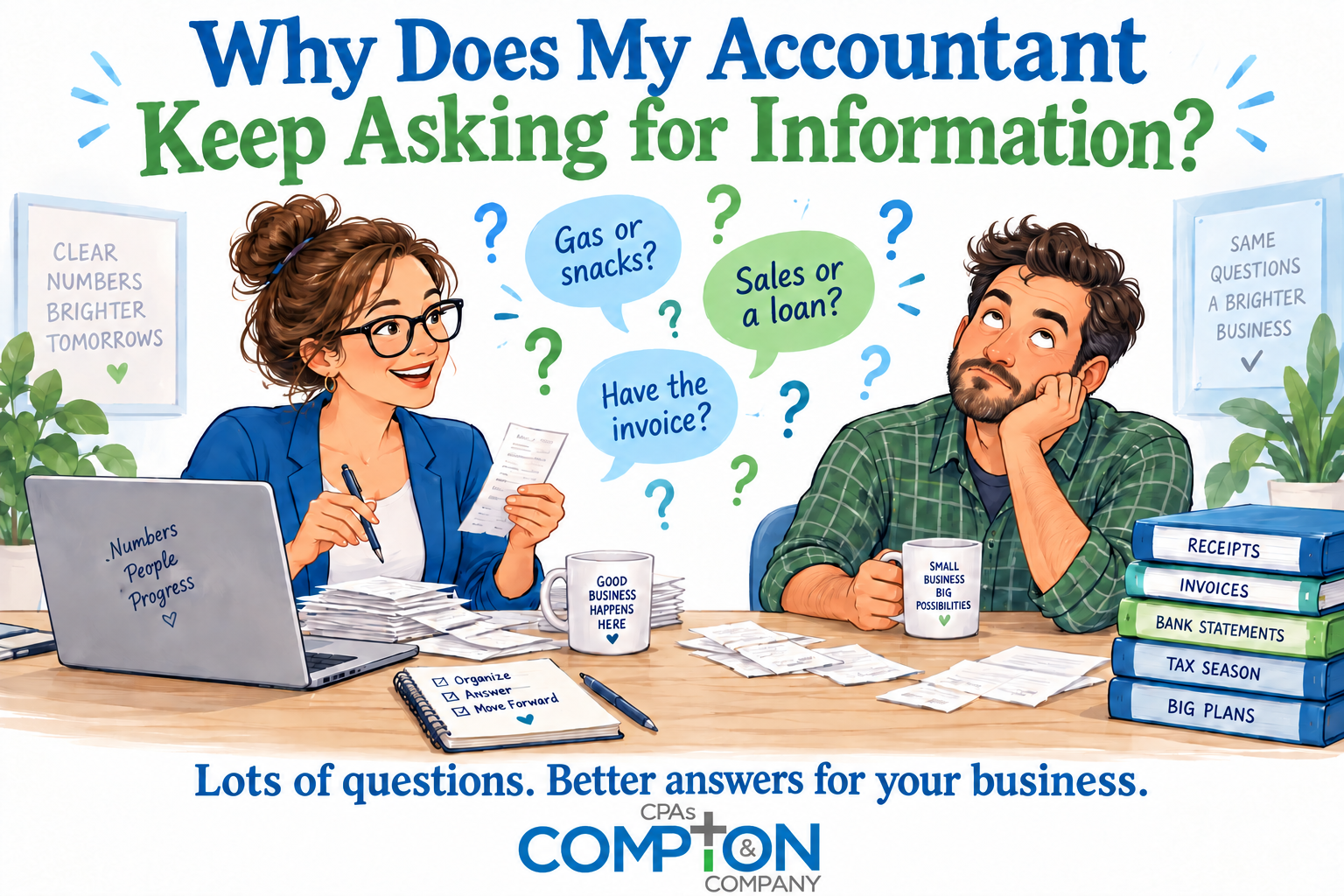
But if you’re wondering, “Why does my accountant keep asking for information?” here’s the reason: we can see the numbers, but we weren’t there when you spent the money. A few details from you can make a big difference in whether your books are right.
An Amazon charge could be printer paper, a new computer, or your daughter’s birthday present. The bank feed may show the same description for all three. It tells us where the money went, but not what you bought or whether it was for the business.
It isn’t only online purchases, either. A charge from “Shell” could be gas, but it could just as easily be snacks from the convenience store or something for the vehicle, like oil or wiper blades. We can go by what’s usual for your account, but I’ve gone back and corrected entries too many times after assuming a transaction was one thing when it turned out to be something else entirely.
Deposits need explanations, too. Money coming into the account could be a customer payment, loan proceeds, or money you moved from another account. We need to know which one it is before we record it.
Telling us it’s all sales is easy, and sometimes that’s exactly right. But loan proceeds and money you move in from your own accounts get treated differently for tax purposes than income does, and lumping them together as sales can overstate what you actually earned. We’ve had to go back and make corrections after a return was nearly finished because a deposit turned out to be a bank loan from late in the year, not income — there hadn’t been any payments yet to flag it.
You know what happened because you made the purchase or arranged the transfer. We need you to share that part with us. “Shelving for the shop” tells us much more than “business expense.”
A bank feed saves time, but it can’t explain an unfamiliar charge or provide paperwork for a new loan. Even if we can log in to your accounts, we may still need an invoice, a statement, or a note from you.
Statements also help us compare your accounting records with the bank’s records and investigate differences. Transactions showing up in the software is one step. Checking that everything is complete and recorded correctly is another.
The IRS recordkeeping guide explains that supporting documents provide the information needed to record business transactions. That is why receipts and invoices still matter even when your accounts are connected to accounting software. Click here to view the guide.
Suppose you tell us a large payment was for a new piece of equipment. That answers our first question. Now we may need the purchase invoice and financing paperwork to understand the full purchase, including any down payment or trade-in.
Those follow-up questions come from what we learn as we review the records. We may not know a document is needed until another item brings it to our attention.
If a transfer gets recorded as sales, your revenue can look higher than it really was. If a personal purchase gets mixed in with business costs, your expenses can look higher. Either mistake changes the picture you get from your reports.
That matters when you’re deciding whether to hire, raise prices, or make a large purchase. You need to know how the business is actually doing.
An unanswered question can also hold up the work. We may be able to finish other parts of the month while we wait, but some reports or filings can’t be completed until the missing information arrives. Sending everything the day before a deadline leaves very little time to review it and resolve anything else that comes up.
You don’t need to learn accounting terms to give us useful information. A short, clear explanation is often enough to get started. A few habits can help:
If a request doesn’t make sense, ask what we need and why. And if you can’t find something, tell us. We can discuss what other records might help instead of letting the question sit unanswered.
Outsourcing your accounting takes work off your plate. It also works best when there is a clear process for getting information from your business to the people handling the books.
Your accountant should make requests clear, explain what is missing, and tell you when it is needed. Your part is to provide the records and the details only you or your team would know. If the same questions come up every month, it may be time to improve how that information is collected.
When a client flags something out of the ordinary, that helps. When a client tells us what every transaction was, that helps even more. And when a client buys a piece of equipment or takes out a loan and sends us the paperwork right away instead of waiting for us to ask, that’s about as good as it gets. We don’t expect you to understand all of this — that’s why you hired us. But the more you can tell us up front, the faster we can work and the fewer questions we’ll have to send back your way. Eventually, we won’t have to ask quite as many questions. Maybe.
At Compton & Company, we help small business owners keep their accounting current and understand their numbers. If gathering records and keeping up with the books has become a constant struggle, contact us to discuss whether our monthly accounting services are a good fit for your business.
Helping you navigate today and plan for tomorrow.
A bank statement usually shows the date, amount, and payee. A receipt or invoice shows what you purchased. Your accountant may also need a short explanation of how the purchase relates to your business.
Let your accountant know when and where you sent it. They can check whether it was received, whether a page is missing, or whether the request is for a different document. If this keeps happening, ask to agree on a better tracking process.
Yes. Regular accounting can reduce the pileup, but your accountant still needs information about unusual transactions and changes in your business. Agree on who will answer questions and when those answers are due.
Say so rather than guess. Check receipts, order histories, or with the employee who made the purchase. Tell your accountant what you can confirm and what is still unknown so you can work out the next step.

Quick Answer: Use a different password for every account. Turn on multifactor authentication (MFA), starting with email, banking, and payroll. Then save your recovery codes…Read More

Quick Answer: AI tools can imitate a voice. Give your team one rule: any request for money, gift cards, passwords, or private information gets confirmed…Read More

Quick Answer: Before you pay a bill, especially one with new bank details, confirm two things by calling a phone number you already have on…Read More
Comments