
I sought the LORD, and He answered me and rescued me from all my fears. Those who look to Him are radiant with joy; their faces will never be ashamed.
Psalm 34:4-5

by
Elizabeth
 Jul 30, 2026
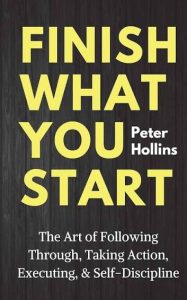
Quick Answer: Finish What You Start by Peter Hollins is a quick, practical read on why we don’t follow through and what actually helps. Below are the few ideas that stuck with me and why the book is worth your time.
Most business owners do not have an idea problem. We have a follow-through problem. I start most weeks with a short, clear to-do list, proof that hope springs eternal. By the end of the day Monday, a few more things have gotten added, a few have been rearranged, and the one thing I actually needed to touch is still sitting there, untouched, quietly judging me from the bottom of the page (or the top of the page, in seemingly bright, neon letters).
That is the whole premise of Finish What You Start by Peter Hollins, and it is why the book stuck with me. I am not going to walk through every chapter here; that is what the book is for. But a few ideas are worth sharing.
Full disclosure: I actually read it about a year ago, and it has taken me this long to sit down and write about it, which might be the most on-the-nose example of my own follow-through problem I could ask for. Reacquainting myself with it for this post, I am starting to think I need to read it again, if only to get better at finishing what I start.
The idea that stuck with me most is almost embarrassingly simple: the “Just 10 Minutes” rule. When you feel the urge to quit something, put it off, or give in to a distraction, you make yourself wait ten minutes before acting on it. Still want to leave after that? You can add another ten. Half the time the urge fades before the clock runs out, and you never have to talk yourself into anything.
A few of the other ideas that stood out: choosing no more than three priorities a day instead of working from an endless list, telling the difference between what is urgent and what is actually important, and building systems instead of leaning on willpower. A goal gets you to the finish line once. A system is ready to run again next week, month, quarter, or year.
It is not a perfect book. No framework survives contact with a real week of client calls, surprise voicemails and emails, and problems nobody scheduled (or wanted). But it gave me a few things worth trying. I am working on capping my list at three real priorities a day, actually sorting the urgent from the important instead of reacting to whichever one is yelling loudest, and doing one thing at a time instead of five things badly at once. The book is blunt about multitasking: you cannot fully focus on the new task, and you cannot fully ignore the one you left, so you lose both ways. Single-tasking is the fix, and apparently so is a clean desk, since your eye is not supposed to catch something that needs straightening while you are trying to concentrate. I am also supposed to be decluttering my workspace, which raises a question the book never quite answers: is finding time to declutter urgent, important, or just one more thing I am rearranging instead of doing? I have not cracked that one yet. Time management and self-discipline are both very much a work in progress over here, but that is sort of the point.
If you have more unfinished projects than finished ones, no judgment from me. We can compare notes. But I do think it is worth the few hours it takes to read.

Quick Answer: It may be time to raise your prices when your costs have gone up, you’re keeping less from each sale, or you’re doing…Read More

What a year of walking (and a still-messy desk) taught me about Darren Hardy’s book “We are what we repeatedly do.” Aristotle said that centuries…Read More

Quick Answer: A small-business worst-case plan should name someone who can make urgent decisions, explain how payroll and critical bills will be handled, identify where…Read More
Comments