
I am at rest in God alone; my salvation comes from Him. He alone is my rock and my salvation, my stronghold; I will never be shaken.
Psalm 62:1-2
by
Elizabeth
 Oct 12, 2026
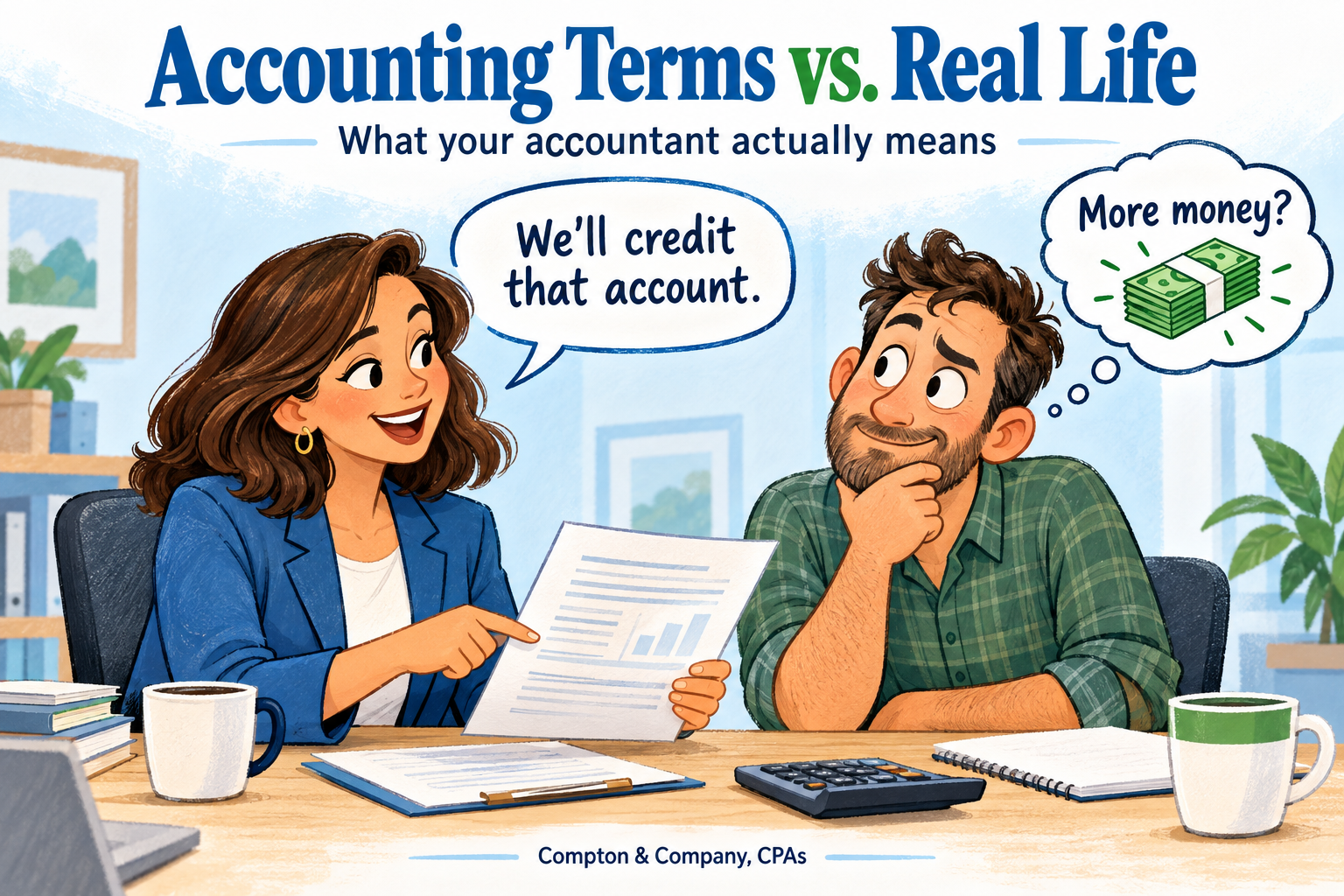
Quick answer: Accounting borrows everyday words—credit, profit, asset—and gives them narrower meanings. A credit isn’t automatically money coming in, a profit doesn’t mean the cash is sitting in your account, and a fully depreciated truck can still be worth something. When a term doesn’t make sense, ask what it means for your business.
Your accountant says, “We’ll credit that account.”
Great! More money, right?
Well…maybe.
Accounting has a way of taking perfectly normal words and giving them a completely different meaning. You recognize every word, but halfway through the conversation you’re not sure you’re talking about the same thing.
Take “credit.” We give credit where it’s due. We say a hardworking employee is a credit to the team. Outside of accounting, a credit is almost always a good thing.
In accounting, it’s just a direction—and sometimes it means money went out the door.
Let’s translate a few of the most common ones into plain English—and talk about why they matter for your business.
When your bank says “debit,” money left your account. When a store gives you a “credit,” you got something back. So it’s natural to assume debits are bad and credits are good.
In accounting, debits and credits are simply the two sides of every entry. Every transaction gets at least one of each, and the totals always match.
Whether a debit or a credit increases an account depends on the type of account. A debit increases assets like cash and equipment, along with expenses and owner’s draws. A credit increases liabilities like loans and credit card balances, along with revenue and owner’s equity.
Say your business is paid $500 for a service. Here’s the entry:
|
Account |
Debit |
Credit |
|
Cash |
$500 |
|
|
Service revenue |
$500 |
Cash went up, so we debit it. Sales went up, so we credit revenue.
Now say you pay $100 for supplies:
|
Account |
Debit |
Credit |
|
Supplies expense |
$100 |
|
|
Cash |
$100 |
This time cash went down, so cash gets the credit.
Same words. Opposite effects, depending on the account.
The real-world translation: When your accountant says “debit” or “credit,” the more useful question is, “Which account—and what does that change?”
Then there’s your bank statement. The bank keeps its records from its side of the relationship: money you deposit is money the bank owes you, so the bank calls your deposit a credit. On your business’s books, that same deposit is a debit to cash.
No wonder this gets confusing.
Your profit and loss statement (P&L) says the business made money this year. Then you open your banking app.
These two numbers appear to have never met.
Profit is revenue minus expenses. Cash is what’s actually in the account. They move for different reasons, and plenty of money can leave the business without touching the P&L. Here’s a simplified example:
|
Net profit for the year |
$60,000 |
|
Less: Loan principal payments |
($12,000) |
|
Less: Down payment on a new truck |
($15,000) |
|
Less: Owner’s draws |
($40,000) |
|
Change in cash for the year |
($7,000) |
Loan principal, equipment purchases, and owner’s draws all use cash, but none of them shows up as an ordinary expense on your P&L. (The interest on your loan does. The principal doesn’t.) The truck will reduce profit gradually through depreciation, which we’ll get to in a minute.
It works the other way, too. When loan money lands in your account, your cash goes up without adding a dime of profit.
Years ago, a client came to us at tax time and couldn’t believe how much they owed. They kept saying, “But I don’t have any money! How did I have income?”
The business was profitable. The problem was where the cash was going: most of it went to loan payments. Only the interest portion of a loan payment is deductible. The principal isn’t. So the business had real taxable income and very little in the bank to show for it.
We weren’t doing their monthly accounting at the time. If we had been, they could have seen that tax bill coming months ahead and had time to plan for it instead of finding out in April. That’s one of the biggest reasons we encourage monthly bookkeeping—surprises are a lot cheaper when you catch them early.
The real-world translation: A profitable business can still be short on cash. Your P&L and your bank balance each tell part of the story, and you need both.
You’ll often see one of these terms at the top of your reports, and it changes what the numbers mean.
Cash basis records income when you’re paid and expenses when you pay them. It’s simple, and it lines up closely with your bank account.
Accrual basis records income when you earn it and expenses when you incur them, whether or not money has changed hands yet. If you invoice a customer in December and they pay in January, accrual counts that sale in December.
Both are legitimate. Accrual gives a truer picture of how the business performed in a given month. Cash basis makes it easier to see what’s actually come in and gone out. Many small businesses file their taxes on the cash basis, and some also look at accrual reports to manage the business.
If your reports are on the accrual basis, your profit can include sales customers haven’t paid for yet—one more reason profit and cash don’t always match. Not sure which one you’re looking at? Ask us.
It’s easy to treat every deposit as income. The bank balance went up, after all.
But a $20,000 business loan isn’t $20,000 in sales. Neither is money you move into the business from your personal account, or a transfer from the business savings account to checking.
Revenue means amounts earned from selling your products or services. Everything else gets recorded as what it really is. A few deposits that commonly trip people up:
That’s why we ask what a deposit was for. The amount alone can’t tell us whether it’s a sale, a loan, an owner contribution, or something else—and getting it right affects both your profit and your taxes.
These sound more complicated than they are.
Accounts receivable is money customers owe your business. You sent an invoice and you’re waiting to get paid.
Accounts payable is money your business owes vendors. You got a bill and haven’t paid it yet.
An easy way to keep them straight: receivable is money you’ll receive, payable is money you’ll pay.
The real-world translation: Receivables show what’s on its way in. Payables show what’s coming due. Look at them together and you’ll have a much better idea whether next month is going to be tight.
If you own a sole proprietorship, a partnership, or a single-member LLC, you probably pay yourself by taking money out of the business. That’s an owner’s draw (some businesses call it a distribution).
Draws reduce your cash and your equity in the business. They don’t appear on your P&L as an expense, so they won’t lower your profit—or your taxes. Owners of these businesses are generally taxed on the business’s profit, no matter how much they actually took out.
S corporations work differently. If you own one and work in the business, you’ll generally need to pay yourself a reasonable salary through payroll, and that salary is a business expense. Distributions on top of your salary work more like draws.
The real-world translation: “I took $40,000 out this year” and “the business made $40,000” are separate numbers. The second one is the one you’re taxed on, and the first one is what you can use to pay the taxes.
Call something an asset in everyday conversation and you mean it’s useful or valuable. In accounting, an asset is anything your business owns or controls that has value: cash, equipment, inventory, and accounts receivable all count.
Not all assets help much when payroll is due Friday, though. A truck may be worth $30,000, but you can’t pay an employee with a tire. Inventory has to sell first. Receivables have to be collected.
The real-world translation: Your business can own a lot of valuable things and still be short on cash. “We have plenty of assets” and “We can make payroll Friday” don’t mean the same thing.
“Depreciation” probably makes you think of your car losing value the minute you drive it off the lot. In accounting, it means something narrower: spreading the cost of a long-term asset, like equipment or a vehicle, over the years you’ll use it.
Buy a $25,000 machine you expect to use for five years, and your books might record $5,000 of depreciation expense each year instead of the full cost up front.
Depreciation is also a non-cash expense. It lowers your profit each year, but no money leaves your account when it’s recorded—the cash went out when you bought the machine.
Tax depreciation follows its own rules. Depending on the asset and the tax law that year, you may be able to deduct much or all of the cost in the year you buy it, so your tax return and your books can show very different depreciation numbers.
None of these numbers is an appraisal of what your equipment would sell for today.
The real-world translation: I’m writing this at a desk we bought 11 years ago. It was fully depreciated years ago, and I still use it every day. “Fully depreciated” just means the cost has been used up on the books. The desk didn’t get the memo.
If there’s one question clients ask us more than any other, it’s “Is this a write-off?” The honest answer is almost always “It depends.”
Even TV can’t get a straight answer. In one Schitt’s Creek scene, Johnny asks David if he knows what a write-off is, and his explanation boils down to: you buy something, and you just…write it off. (Watch it here if you need a quick laugh.) Seinfeld did its own version decades before, with Kramer insisting the Post Office will simply write off Jerry’s broken stereo (here’s that one). Plenty of real business owners are in the same spot—they’ve heard the term a hundred times, but nobody ever explained it.
A write-off (the tax term is a deduction) is a business expense that reduces your taxable income. Whether something qualifies depends on a few things: whether it’s an ordinary and necessary expense for your type of business, whether there’s personal use mixed in, and whether it’s deducted all at once or spread out over several years, like that desk. And as our loan-payment client learned, sometimes only part of a payment counts.
A write-off also saves you less than most people think. If you’re in the 24% federal tax bracket, a $1,000 deduction saves you about $240 in federal income tax. You still spent the other $760.
The real-world translation: Before you buy something “for the write-off,” call us. We’ll tell you whether it’s deductible and what it will actually save you, and then you can decide if it’s worth it.
When two people reconcile, they patch things up after a disagreement. When we reconcile your accounts, we compare your books to an outside record—usually a bank or credit card statement—line by line, and make sure every difference has an explanation.
Some differences are just timing. A check you wrote on the 29th might not clear until next month, and a deposit you made on the 31st might not show up at the bank until the 2nd. Others are real problems: a transaction that never got recorded, one that got recorded twice, or a charge nobody recognizes.
The real-world translation: Reconciliation is how we know your books are accurate. It’s also one of the best ways to catch errors—and even fraud—early.
You shouldn’t need an accounting degree to understand what’s going on in your business.
If a term doesn’t make sense, stop us and ask: “What does that mean for me?”
That’s usually where the useful conversation starts. What do customers owe you? What bills are coming due? Why did profit go up while cash went down?
At Compton & Company, CPAs, we help you understand your numbers so you can make confident decisions about your business.
Helping you navigate today and plan for tomorrow.

Quick Answer: Never change an employee’s direct deposit based on an email alone. Confirm it in person or by calling the phone number already in…Read More

Quick Answer: Tell someone right away, whether that’s your IT provider, whoever handles security, or your bank. Then, depending on what happened, change any password…Read More

Quick Answer: Use a different password for every account. Turn on multifactor authentication (MFA), starting with email, banking, and payroll. Then save your recovery codes…Read More
Comments