
I sought the LORD, and He answered me and rescued me from all my fears. Those who look to Him are radiant with joy; their faces will never be ashamed.
Psalm 34:4-5
by
Elizabeth
 Jul 02, 2026
Quick Answer:
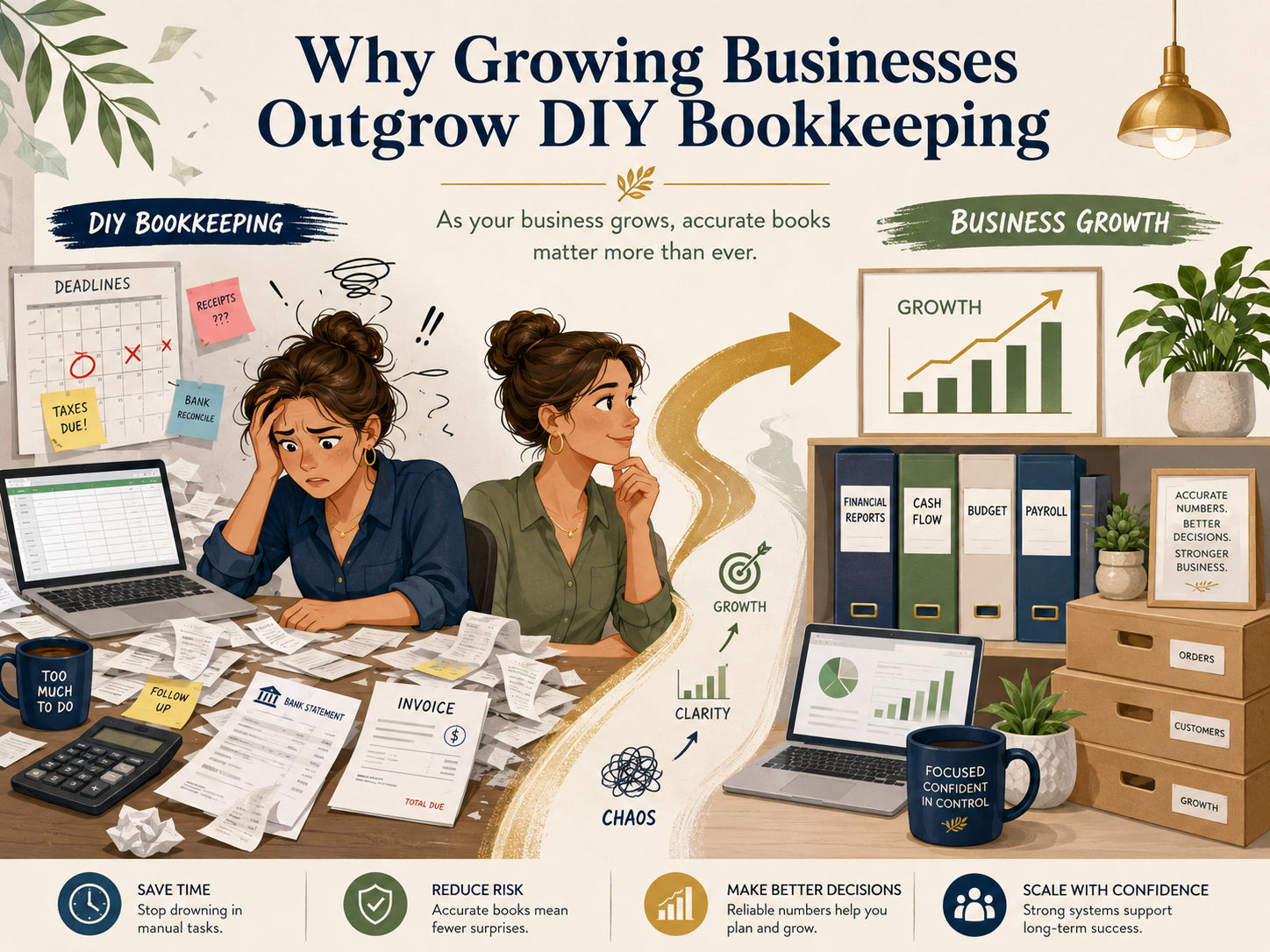
DIY bookkeeping can work when your business is small. But as you grow, your books need more detail, more review, and better reports. If your records are behind, your accounts are messy, or you do not trust your numbers, it may be time to get professional help with your monthly accounting.
Most business owners start out doing their own bookkeeping. In the early days, there is not much to track. A few deposits, a few bills, one bank account.
The goal at that stage is simple: keep up with income and expenses, hold onto your receipts, and have enough pulled together for tax time.
But growth changes things fast.
DIY bookkeeping is not wrong. It just has limits.
Think of it this way: a business can outgrow its bookkeeping the same way it outgrows a small office or a basic phone system. What worked at one stage is not always enough at the next.
When the business gets busier, the books need to do more than record what already happened. They need to help you understand what is happening right now.
Sometimes it is not about outgrowing DIY bookkeeping at all. As a business owner, your time is money. Every hour you spend reconciling accounts, chasing down receipts, or trying to make your books make sense is an hour you are not spending on your clients, your team, or your family. Outsourcing your bookkeeping is one of the simplest ways to get that time back – and put it toward something that actually moves your business forward.
When you are running a business, bookkeeping gets pushed aside fast. Client work, employees, bills, payroll, and customer problems feel a lot more urgent than reconciling last month.
Then one month turns into three. Before you know it, tax time is here and the books are not ready.
I see this constantly with business owners across Mississippi, Tennessee, and Alabama. Behind books do not just create stress. They make it nearly impossible to know where your business actually stands.
As a business grows, the number of transactions grows too. More payments, more loans, more credit cards, more subscriptions, and more deposits can make the books harder to manage.
One of the most common mistakes I see is loan payments coded as an expense instead of being split between principal and interest. Owner draws, payroll items, sales tax, and reimbursements can all get mixed up the same way.
The result is a profit and loss statement that does not tell the full story. And that is a problem when you are trying to make decisions.
A bank reconciliation is how you match your books to your bank statement. This step catches missing items, duplicate entries, and errors before they become bigger problems.
When reconciliations are skipped or rushed, your reports may look finished but still be wrong.
Wrong numbers lead to bad decisions. It is that simple.
A business can show a profit on paper and still feel tight on cash. That happens when money is tied up in accounts receivable, inventory, debt payments, or taxes.
DIY bookkeeping often stops at entering income and expenses. A growing business needs more than that. You need to know when money is coming in, when it is going out, and what may be around the corner.
Good bookkeeping does not magically fix cash flow, but it can help explain it.
Once you have employees, payroll adds a whole new layer. Wages, payroll taxes, benefits, reimbursements, and contractor payments all need to be handled correctly.
Sales tax is another one. Collecting sales tax does not mean that money belongs to your business. It needs to be tracked and paid to the right agency on time.
These things are easy to mishandle when bookkeeping is happening late at night or only when there is a spare hour.
Messy books make tax time more expensive, more stressful, and more rushed. I have seen it happen more times than I can count.
If the records are not clean, your tax preparer has to spend extra time fixing things before they can even start the return. That takes time, and time costs money.
Clean books during the year can reduce those surprises and cut down on last-minute calls from your CPA.
A growing business owner needs real answers. Are sales up? Are expenses out of line? Is payroll eating too much of your revenue?
DIY bookkeeping often cannot give you those answers in a useful way.
When the reports are hard to trust, you end up guessing. And guessing is not a strategy.
As a business grows, bookkeeping should become part of how you manage the business every month. Not just something you think about when taxes are due.
A growing business usually needs:
This does not mean giving up control. It means getting better information and more time to focus on the business itself.
You may have outgrown DIY bookkeeping if any of these sound familiar:
If several of these sound familiar, you are not alone — and you do not have to keep pushing through it. Reach out and let’s talk about what a better monthly system could look like for your business.
Professional monthly accounting gives the business a better system. The goal is not just to enter transactions. The goal is to keep the books organized, review the numbers, and help the owner understand what the reports are saying.
For many business owners, this brings peace of mind. Instead of wondering whether the books are right, they have a process. Instead of waiting until tax time, they can review their numbers during the year.
That can make a big difference when the owner is trying to plan, hire, price jobs, manage cash, or decide what comes next.
Outgrowing DIY bookkeeping is not a failure. More often than not, it is a sign the business is doing well.
The real problem is waiting too long to make a change. Messy books can hide problems, create tax stress, and make decisions harder than they need to be.
If your bookkeeping no longer fits where your business is today, it may be time to put a better monthly system in place. You do not have to figure that out alone.
When should a small business stop doing its own bookkeeping?
When the books are behind, the reports are confusing, or there is no longer enough time to keep them clean.
Is DIY bookkeeping okay for a new business?
Yes. DIY bookkeeping can work for a very small or brand-new business. As the business grows, it often needs a stronger system and regular review.
What is the biggest risk of DIY bookkeeping?
Making decisions based on numbers that are incomplete or wrong. Poor bookkeeping can also create real problems at tax time.
What does monthly accounting include?
Typically: bookkeeping, bank reconciliations, payroll-related entries, financial reports, and practical help understanding what the numbers mean.

Quick Answer: It may be time to raise your prices when your costs have gone up, you’re keeping less from each sale, or you’re doing…Read More

What a year of walking (and a still-messy desk) taught me about Darren Hardy’s book “We are what we repeatedly do.” Aristotle said that centuries…Read More

Quick Answer: A small-business worst-case plan should name someone who can make urgent decisions, explain how payroll and critical bills will be handled, identify where…Read More
Comments