
I sought the LORD, and He answered me and rescued me from all my fears. Those who look to Him are radiant with joy; their faces will never be ashamed.
Psalm 34:4-5
by
Elizabeth
 Jul 13, 2026
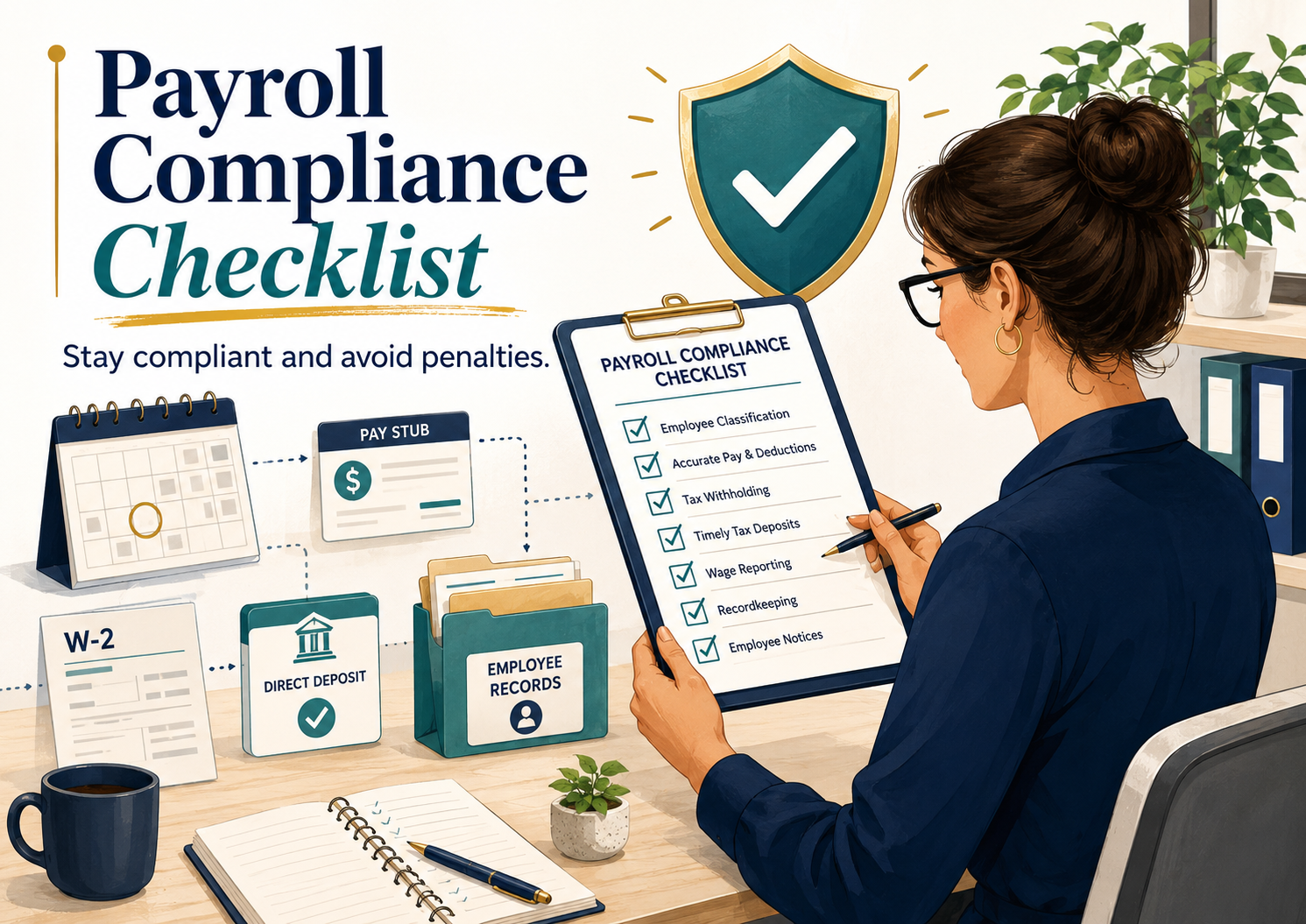
Quick Answer: Payroll compliance means paying your employees correctly, withholding payroll taxes, depositing those taxes on time, filing the right forms, and keeping good records. A simple checklist helps catch problems before they turn into penalties.
Here is something we see more than we would like. A business owner gets an IRS notice in the mail. Payroll taxes are late. Penalties are stacking up. And no one caught it until the letter arrived.
We work with small business owners in Mississippi, Tennessee, and Alabama. Payroll is one of the areas where we see the most stress — and the most preventable problems.
Payroll looks simple from the outside. You pay your team, send in the taxes, and file the reports. But behind each paycheck are rules about tax rates, overtime, deadlines, employee forms, and deductions. When everything works, payroll is quiet. When something goes wrong, it shows up as notices, penalties, and headaches.
This checklist will help you know what to review, what to keep, and where the small mistakes usually hide.
Payroll compliance means your business is following the rules for paying workers and reporting payroll to the government. Those rules come from the federal level, your state, and sometimes your city or county.
For most small businesses, payroll compliance covers:
It is not just about cutting checks. Payroll touches taxes, bookkeeping, employee records, and cash flow.
Use this as a practical review — not just a one-time exercise. You may not handle every step yourself, but you should know someone is handling it.
Do not wait until payday to collect paperwork. If you are missing a form, you may withhold the wrong amount — or create a records problem that shows up at year-end.
Before a new employee is paid, make sure you have:
One missed form can turn into a real problem when W-2s are due in January.
This is one of the most common — and costly — mistakes we see. The question is simple: is this person an employee or an independent contractor?
Employees have payroll taxes withheld from their checks. Contractors are generally paid without that withholding, and you may need to file a Form 1099-NEC for them if you pay them $600 or more during the year.
If you treat an employee as a contractor, you could owe back taxes, penalties, and interest. The IRS and state agencies both look at this carefully. When there is any doubt about how to classify someone, it is worth reviewing before you make that first payment.
A common misconception: if someone is salaried, they do not get overtime. That is not always true.
Under federal law, most salaried employees earning below a certain threshold must still be paid overtime when they work more than 40 hours in a workweek. Even above that threshold, the employee’s actual job duties matter. Some roles qualify for overtime exemption; others do not.
State rules can add more requirements on top of federal rules. Keep clear records of hours worked, time off, and pay changes. Good records protect both you and your employee.
Before you run payroll, take a few minutes to check for anything that changed since the last cycle. This quick review prevents the cleanup project later.
Look for:
Small changes add up. A raise that was not entered or a garnishment that was missed can be a bigger problem than it sounds.
Most employee paychecks include federal income tax withholding, Social Security tax (6.2%), and Medicare tax (1.45%). Depending on where your business operates, there may also be state income tax withholding or other payroll taxes.
On top of what you withhold from employees, you also owe employer-side payroll taxes. That includes the employer share of Social Security and Medicare taxes, plus federal and state unemployment taxes.
Payroll taxes are trust-fund taxes. The money withheld from employee checks is not business operating money. It belongs to the government. Spending it — even accidentally — can lead to serious personal liability for the business owner.
Filing the payroll tax return is not the same as paying the tax. These are two separate things with separate deadlines.
How often you deposit payroll taxes depends on your deposit schedule — which is based on how much payroll tax you reported in a prior lookback period. Many businesses deposit monthly or semiweekly. The right schedule for your business may be different.
Missing a deposit deadline can trigger a penalty even if your tax return is filed on time. This is why payroll due dates belong on a calendar — not just in someone’s memory.
Payroll tax deposits and payroll tax returns are both required. Here are the most common federal filings:
Year-end payroll filings are much easier when your records have been clean all year. The best year-end payroll process starts in January — not the following December when you are scrambling to figure out what happened.
Payroll should not live in its own world, separate from your accounting records. Every paycheck, tax deposit, payroll fee, and benefit payment should show up correctly in your books.
A good payroll reconciliation helps catch:
Payroll affects your profit and loss, your balance sheet, your tax return, and your cash flow. When payroll is off, everything downstream is off too.
If the IRS, your state tax agency, the Department of Labor, a lender, or an employee asks a question about payroll — you want to be able to answer it without digging through old emails and random folders.
Keep records including:
Different records have different retention requirements. When you are not sure, keep it and ask your payroll or accounting professional before deleting anything. The general rule of thumb is to keep payroll records for at least four years.
Federal payroll rules are just the starting point. Your state likely has its own rules for withholding, unemployment, minimum wage, new hire reporting, workers’ compensation, final paycheck timing, and paid leave.
If you hire a remote employee in another state, payroll gets more complicated. You may need to register in that state, follow that state’s tax rates, and meet that state’s filing deadlines. This is easy to miss — and the state will eventually notice.
Before bringing on someone in a new state, find out what is required before they start. It is much easier to set it up right the first time.
Payroll mistakes happen because there are a lot of moving pieces. Here are the ones we see business owners overlook most often:
The fix is not panic — it is a payroll process that gets reviewed every pay period, every month, every quarter, and every year.
Payroll compliance is easier when it is part of a regular routine. Here is what that looks like:
|
When |
What to Review |
|
Each Payroll |
Hours, pay changes, new hires, terminations, deductions, and available cash. |
|
Monthly |
Payroll reports, tax payments, benefit payments, and payroll entries in the books. |
|
Quarterly |
Payroll tax returns (Form 941), state unemployment reports, and payroll tax balances. |
|
Year-End |
W-2s, employee addresses, fringe benefits, owner payroll, and payroll totals for tax returns. |
|
Anytime Something Changes |
New state, new employee type, new benefit, new pay plan, or a payroll notice in the mail. |
At Compton & Company, CPAs, we work with small business owners who want payroll to be one less thing to worry about.
We can help with:
We are not an employment law firm, and some questions about HR or terminations may need an attorney or HR specialist. But the payroll tax side, the filings, the reconciliation, the notices — that is exactly what we do.
When payroll is handled well, you can stop worrying about forms and deadlines and get back to running your business.
Payroll compliance is not about making payroll harder. It is about building a process that protects your business, your employees, and your cash flow.
A good checklist helps you stay ahead of deadlines, catch mistakes early, and avoid penalties that did not have to happen. If payroll has started to feel messy, rushed, or stressful, now is a good time to get help — before the next notice shows up.
Payroll compliance means following the rules for paying employees, withholding taxes, depositing payroll taxes on time, filing payroll reports, and keeping organized payroll records.
Most employers file Form 941 each quarter, Form 940 once a year, and Forms W-2 and W-3 at year-end. State payroll reports are required too, and the exact forms depend on your state.
Late deposits trigger penalties — and those penalties grow the longer it sits. The IRS takes payroll tax deposits seriously because the withheld amounts belong to the government, not the business.
Yes. Software helps process payroll, but the business owner is still responsible for entering correct information, meeting deadlines, and responding to notices. Software does what you tell it to do — it does not catch everything.
Yes! We handle live payroll for clients all over Mississippi, Tennessee, and Alabama, including handling year-end reporting. Let us take that off your plate! Note: employment law questions may still need an attorney or HR professional, but the tax and reporting side is right in our wheelhouse.

Quick Answer: It may be time to raise your prices when your costs have gone up, you’re keeping less from each sale, or you’re doing…Read More

What a year of walking (and a still-messy desk) taught me about Darren Hardy’s book “We are what we repeatedly do.” Aristotle said that centuries…Read More

Quick Answer: A small-business worst-case plan should name someone who can make urgent decisions, explain how payroll and critical bills will be handled, identify where…Read More
Comments