
I sought the LORD, and He answered me and rescued me from all my fears. Those who look to Him are radiant with joy; their faces will never be ashamed.
Psalm 34:4-5

by
Elizabeth
 Aug 10, 2026
Quick Answer: A balance sheet shows what your business owns, what it owes, and what is left for the owners on one date. An income statement shows sales, costs, expenses, and profit over a period of time. You need both reports to see the full picture.
Last weekend, my oldest daughter saw me working and started asking all the questions. What was I doing? What did the numbers mean? Why were there two reports? How could one number be good while another one looked bad? Why is a debit good over here but bad over there?
Her questions made me think about the business owners I work with every day. Most owners know their own business very well. They know their customers, their work, and the daily problems they must solve. But many were never taught how to read the books behind the business.
That is nothing to be embarrassed about. Financial reports use words that can sound harder than they are. Once you know what each report is meant to show, the numbers start to make much more sense.
The same report may have more than one name. Your accountant may use one name while your bookkeeping software uses another and your banker a third. These are the names you will see most often:
|
Main name |
Other common names |
What it covers |
|
Balance sheet |
Statement of financial position, statement of assets, liability, and equity |
One date, such as June 30 |
|
Income statement |
Profit and loss statement, P&L, statement of operations, statement of revenue and expenses, or statement of earnings |
A period, such as June 1-30 or January 1-June 30 |
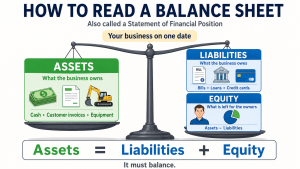
A balance sheet is a snapshot of your business on one date. Think of it like a photo: it captures where things stood at the close of that one day, not everything that happened during the month.
The balance sheet follows a basic rule:
The Formula: Assets = Liabilities + Equity
Assets are things the business owns or has the right to collect. This can include cash, account receivable, inventory, equipment, vehicles, and buildings.
You may see current assets and long-term assets. Current assets should turn into cash, be sold, or be used within about one year. Long-term assets are kept longer.
Liabilities are amounts the business owes. This can include unpaid bills, credit cards, payroll taxes, sales taxes, lines of credit, and loans.
Current liabilities are usually due within one year. Long-term liabilities are paid over a longer time.
Equity is the owners’ part of the business after debts are taken away from assets. It may include money the owners put in, profits the business kept, and money the owners took out.
The labels in the equity section can change based on the type of business. You may see owner’s equity, partner capital, stockholders’ equity, retained earnings, draws, or distributions.
Important: A balance sheet can balance and still have mistakes. Old customer balances, missing loans, duplicate accounts, or personal items may still make the report wrong.
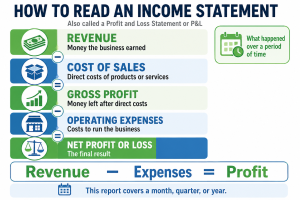
An income statement shows what happened over a period of time. If the balance sheet is a photo, the income statement is more like a video. It shows how the business earned money and where that money went.
This report may be called a profit and loss statement, a P&L, a statement of operations, or a statement of earnings. The name changes, but the basic goal is the same.
This is the money the business earned from its normal work. Some reports call it revenue. It should be split into useful groups when the business has more than one type of sale or service.
These are costs tied closely to what you sold. A repair shop may show parts here. A contractor may show job materials. A service business may have little or nothing in this section.
Gross profit is sales minus direct costs. It shows how much is left to pay the regular costs of running the business.
These are the normal costs of running the business. Common examples are payroll, rent, insurance, software, phone service, repairs, and office costs.
Net income is what is left after expenses. If the number is positive, the report shows a profit. If it is negative, the report shows a loss.
Here is a very simple example:
Sales: $100,000
Minus Direct costs: $40,000
Gross profit: $60,000
Minus Operating expenses: $50,000
Net income: $10,000
In this example, the business kept $10 of profit for every $100 of sales. That does not mean the bank account went up by $10,000. We will come back to that in a moment.
This is one of the most common points of confusion. Your income statement may show a profit while the bank account is low. The report may also show a loss while cash went up.
Here are a few reasons:
Bottom Line: Profit comes from the income statement. Where the cash actually went, and what the business owns and owes, comes from the balance sheet. You need both to see the full picture.
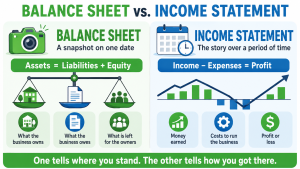
The reports are connected. Profit from the income statement affects equity on the balance sheet. But cash also changes when the business collects old invoices, borrows money, buys equipment, pays debt, or gives money to the owners.
That is why looking at only one report can give you the wrong idea. A good profit does not always mean strong cash. A large bank balance does not always mean the business is doing well. Some of that cash may be needed for taxes, unpaid bills, or debt.
You do not have to study every line. Start with these questions:
Reports are useful only when the books are up to date. Bank and credit card accounts should be reconciled. Loans should match the lender records. Payroll and tax balances should be checked. Old customer and vendor balances should be reviewed.
If those steps have not been done, you may be making choices based on numbers that are not ready yet.
You went into business to do work you’re good at. Financial statements probably weren’t part of the plan, and that’s fine — knowing the basics is enough to help you ask better questions and make better choices.
I can’t fix your car, landscape a yard, paint a house, or diagnose what’s wrong when you’re feeling sick. I’m not trained for any of that, and I know to call a professional when I need one. The same works in reverse – you can call me for the financial side.
At Compton & Company, CPAs, we prepare financial reports for our monthly accounting clients and explain them in an easy-to-understand format. We also help owners spot changes, plan ahead, and understand what the numbers may mean for the business.
If your balance sheet or income statement feels like a foreign language, we can walk you through it in plain English and help you understand the story behind the numbers.
A balance sheet is a snapshot as of one date — assets, liabilities, and equity. An income statement covers a stretch of time and shows sales, costs, expenses, and the profit or loss that resulted.
Yes. A profit and loss statement, P&L, income statement, statement of operations, and statement of earnings are common names for the same basic report.
You need both. The income statement shows whether the business made a profit. The balance sheet shows its cash, debt, other assets, and equity. One report cannot tell the full story by itself.
Cash may be tied up in unpaid customer invoices, inventory, equipment, loan payments, taxes, or owner distributions. Profit measures income and expenses. It does not track every way cash moves.
Most owners should review them each month after the books are closed and the main accounts are reconciled. Fast-growing or cash-tight businesses may need to review key numbers more often.
No. The accounting formula can balance even when an item is missing or in the wrong account. A balance sheet should also be reviewed for old, unusual, or incorrect amounts.

What a year of walking (and a still-messy desk) taught me about Darren Hardy’s book “We are what we repeatedly do.” Aristotle said that centuries…Read More

Quick Answer: A small-business worst-case plan should name someone who can make urgent decisions, explain how payroll and critical bills will be handled, identify where…Read More

Quick Answer: Remote employees can help a small business hire from a larger group of people, reduce office costs, and offer more flexibility. But remote work…Read More
Comments