
I sought the LORD, and He answered me and rescued me from all my fears. Those who look to Him are radiant with joy; their faces will never be ashamed.
Psalm 34:4-5
by
Elizabeth
 Jul 20, 2026
|
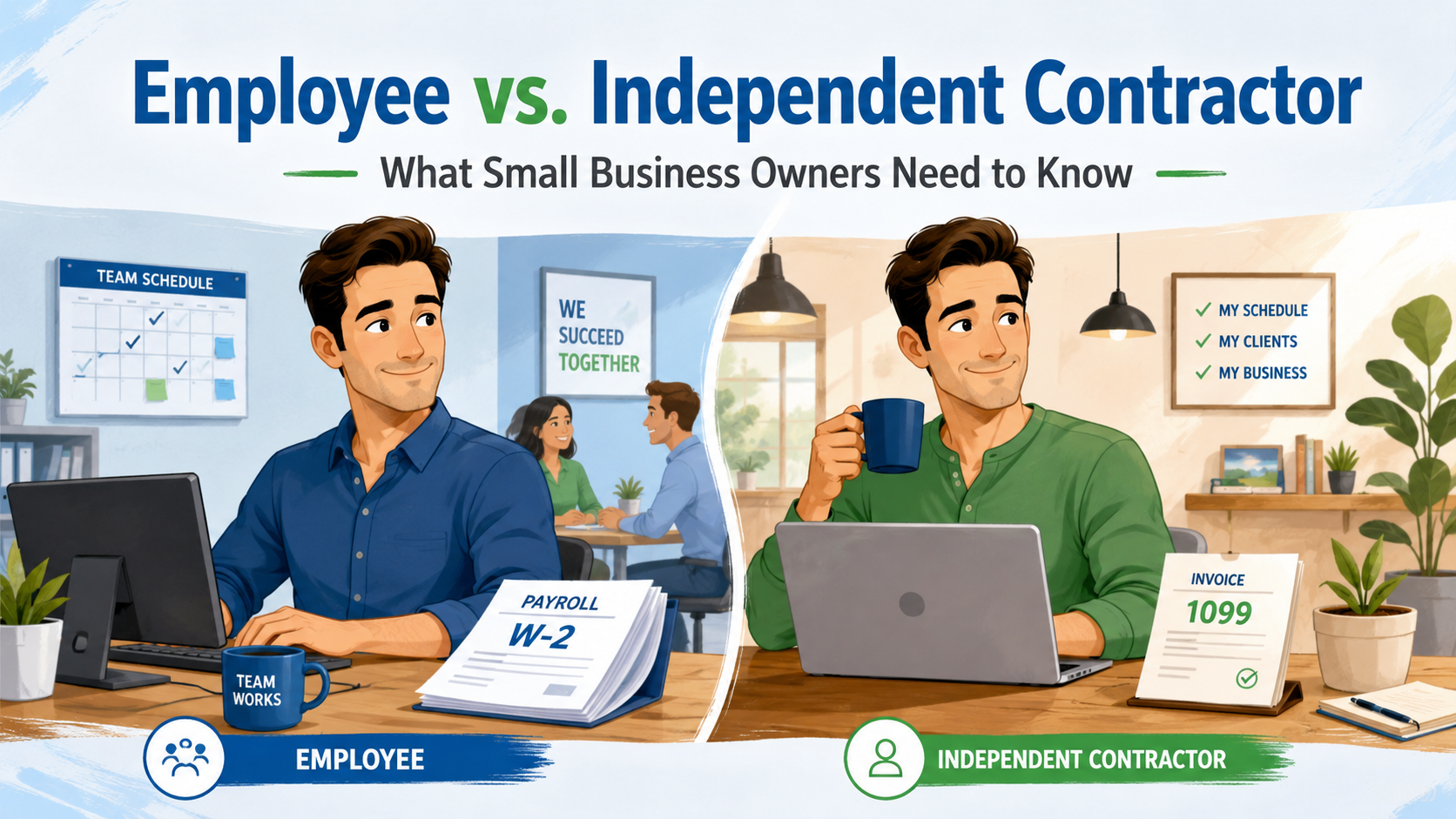
QUICK ANSWER: An employee works as part of your business, and you generally have the right to control when, where, and how the work is done. An independent contractor runs a separate business and controls how the job is completed. Calling someone a contractor, paying them through accounts payable, or giving them a 1099 does not make them an independent contractor. |
Hiring your first (or fifth) helper is a milestone for any small business. It also raises a question that sounds simple but rarely is: is this person an employee or an independent contractor?
It’s tempting to pick whichever label costs less or feels easier to manage. But classification isn’t a choice you get to make. It has to match how the work actually happens, not what’s convenient on paper.
Employees and contractors are paid and taxed differently. They may also receive different protections under wage, unemployment, workers’ compensation, and other laws.
|
Topic |
Employee |
Independent Contractor |
|
How paid |
Through payroll |
Usually by invoice |
|
Taxes |
Business withholds payroll taxes and pays the employer share |
Worker generally pays their own income and self-employment taxes |
|
Year-end form |
Form W-2 |
Usually Form 1099-NEC when reporting rules apply |
|
Control |
Business often controls the work process |
Worker usually controls how the project is completed |
|
Business risk |
Usually little personal profit-or-loss risk |
May invest money, have expenses, and earn a profit or loss |
Get it wrong, i.e. treating someone as a contractor who should have been an employee, and the business can end up owing back payroll taxes, interest, and penalties, on top of wage claims, overtime disputes, and state-level problems.
For federal employment tax purposes, the IRS sorts the relevant facts into three buckets. No single fact settles the question; you have to weigh the whole picture.
Behavioral control is about how much say the business has over the way the work gets done.
The more control a business keeps over those details, the more the relationship looks like employment.
Financial control asks whether the worker is genuinely running their own business.
An independent contractor usually has money invested in their own business and carries some financial risk.
Type of relationship comes down to how the business and worker actually understand and carry out the arrangement.
A written contract is helpful, but it cannot change the facts. An agreement that says “independent contractor” does not settle the issue by itself.
“They only work part time, so they are a contractor.” Part-time workers can still be employees.
“The worker asked to be paid by 1099.” The worker’s preference does not control the classification.
“We signed an independent contractor agreement.” The real working relationship matters more than the title of the contract.
“They work from home.” Remote work does not automatically make someone a contractor.
“They have an LLC.” Having an LLC may support a separate business, but it does not decide the answer.
“We pay them a flat amount instead of hourly.” The payment method is only one fact among many.
Example 1: The office assistant
A business hires someone to work Monday through Thursday from 9:00 to 2:00. The person uses the company’s computer, follows company procedures, answers to a manager, and expects the work to continue. Even if the person works only 20 hours a week, this relationship likely looks more like an employee.
Example 2: The photographer
A business hires a photographer for one staff photo session. The photographer sets the price, uses their own equipment, decides how to complete the work, serves other clients, and sends an invoice. This relationship likely looks more like an independent contractor.
A bookkeeping example can go either way. An outside bookkeeping firm that serves many clients and controls its own work process may be an independent contractor. An in-house bookkeeper who works a set schedule, follows company procedures, and reports to management may be an employee.
For payments made during 2026, the federal Form 1099-NEC reporting threshold is generally $2,000 for reportable service payments. The threshold in future years will be adjusted for inflation, and exceptions and special reporting rules may apply.
Some situations are close calls. The IRS allows a business or worker to file Form SS-8 and request a formal worker-status determination for federal employment tax purposes. Keep in mind that the IRS, the Department of Labor, and state agencies may use different tests for different laws.
One thing to watch: the DOL’s own test is currently in flux. In February 2026, the agency proposed replacing its current multi-factor standard with a leaner test that puts most of the weight on two factors — how much control the business has, and whether the worker has real opportunity for profit or loss. The comment period closed in April, and a final rule is expected sometime in the coming months. If you’re leaning on the DOL side of this analysis, it’s worth checking whether that rule has been finalized since this was published.
For a close or high-risk situation, it is wise to review both the tax and employment-law sides before you begin paying the worker.
Worker classification touches everything downstream — payroll, tax filings, bookkeeping, and year-end reporting. We can walk through the facts with you, get employees set up correctly, collect the right contractor paperwork, and prepare your W-2s and 1099-NECs. When a situation calls for a legal opinion, we can help you frame the right questions for an employment attorney.
It’s always easier to get this right at the start than to unwind it after months, or years, of payments.
Can I change an employee to an independent contractor?
Only if the actual working relationship changes. New paperwork or a new payment method alone isn’t enough.
Can a contractor work for only one business?
Possibly. Working for a single business doesn’t automatically make someone an employee, but paired with tight control, an open-ended relationship, and little financial risk, it’s a warning sign.
Can the same person receive both a W-2 and a 1099-NEC from the same business?
Rarely. It may be appropriate when the person performs separate services and the contractor work independently meets the classification rules. A business should not divide ordinary employee pay between a W-2 and a 1099 simply to reduce payroll taxes. This should be handled carefully and documented well.
What happens if I classify someone incorrectly?
The business may owe payroll taxes, interest, penalties, overtime, unemployment costs, workers’ compensation costs, or other amounts.
Who should I ask when I am unsure?
Start with your CPA or payroll adviser for the tax and reporting side, and loop in an employment attorney for wage and state-law questions. Form SS-8 is also available if you want a formal IRS determination.

Quick Answer: It may be time to raise your prices when your costs have gone up, you’re keeping less from each sale, or you’re doing…Read More

What a year of walking (and a still-messy desk) taught me about Darren Hardy’s book “We are what we repeatedly do.” Aristotle said that centuries…Read More

Quick Answer: A small-business worst-case plan should name someone who can make urgent decisions, explain how payroll and critical bills will be handled, identify where…Read More
Comments
[…] An independent contractor can be the right choice for a true outside business or a set project. It is not a label a business can use only because payroll costs more. The real working relationship decides the classification. For more detail, read Employee vs. Independent Contractor: What Small Business Owners Need to Know. […]
August 13, 2026 at 7:03 pm