
I sought the LORD, and He answered me and rescued me from all my fears. Those who look to Him are radiant with joy; their faces will never be ashamed.
Psalm 34:4-5
by
Elizabeth
 Jul 27, 2026
|
Quick Answer: The best way to pay yourself depends on how your business is taxed. Sole proprietors and most partners take owner’s draws or distributions. S corp and C corp owners who work in the business pay themselves through payroll, and there are IRS rules that back that up. Get this wrong and it can cost you in taxes, penalties, or both. |
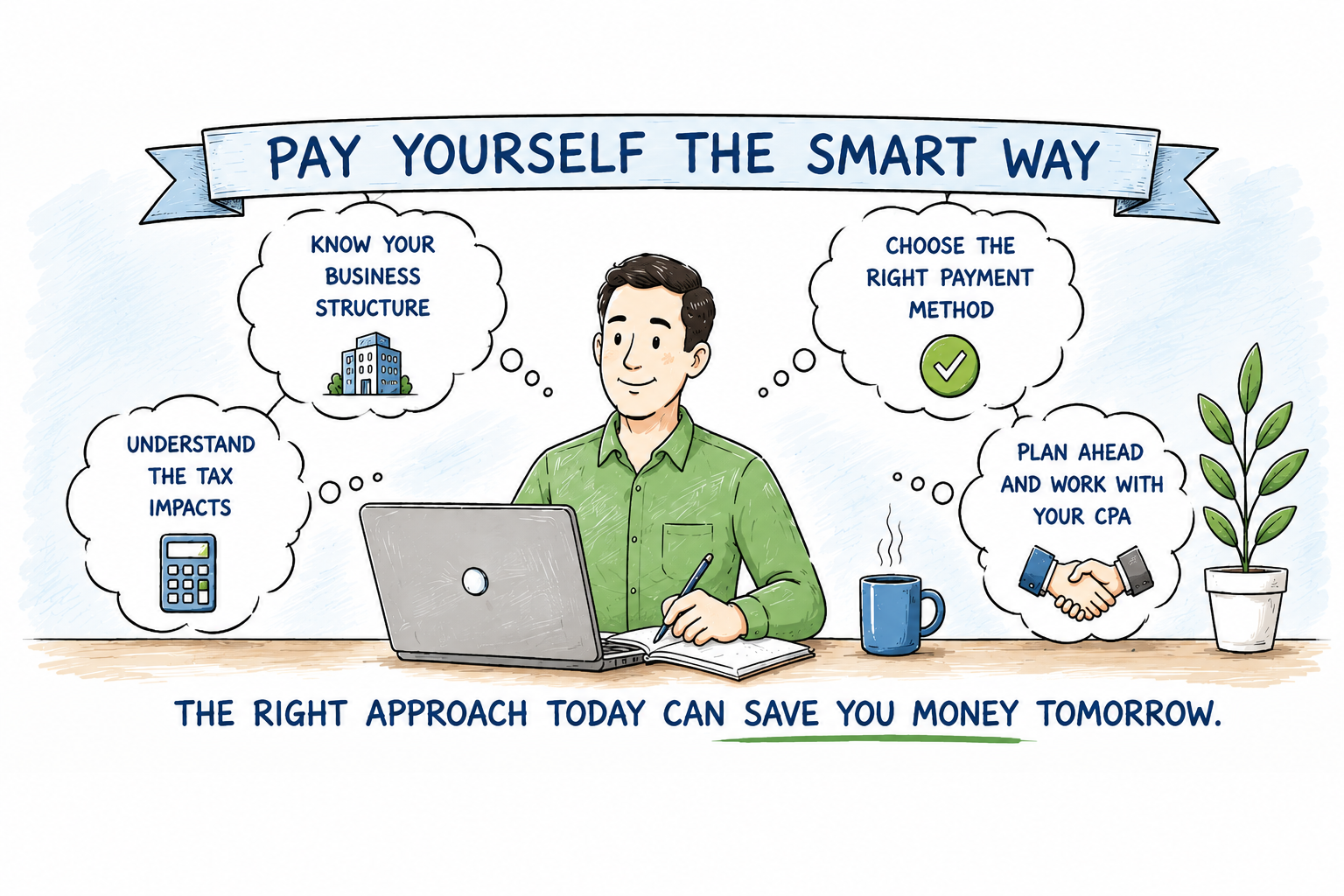
“How should I pay myself?” is one of the first questions we hear from new business owners, and one of the most consequential to get right. It affects your personal tax bill, your IRS compliance, and how much you actually keep at the end of the year.
Below we break down the rules for each structure so you know what applies to your situation.
|
Important: Your legal structure and your tax classification are not always the same thing. An LLC, for example, can be taxed as a sole proprietorship, a partnership, an S corporation, or a C corporation. Everything below is based on tax classification — not the legal entity type on your formation documents. |
If you operate as a sole proprietor or a single-member LLC that hasn’t elected a different tax status, you don’t pay yourself a salary. You take what’s called an owner’s draw: you simply transfer money from the business to yourself.
Here’s the part that catches people off guard: you owe tax on your business profits whether you withdraw the money or leave it sitting in the business account. The IRS doesn’t care that you didn’t touch it.
|
Example: Sarah’s freelance business earns $80,000 in profit. She only withdraws $50,000 to cover her living expenses. She still owes income tax and self-employment tax on the full $80,000. |
Tax considerations:
In a partnership, owners typically take distributions rather than paychecks. Some partners also receive guaranteed payments, fixed amounts paid regardless of whether the business is profitable, and treated differently for tax purposes.
Like sole proprietors, partners are taxed on their share of the income whether or not they actually withdrew the cash. This surprises a lot of people.
|
Example: Two equal partners each have $100,000 of income show up on their K-1. One partner withdrew $60,000. The other withdrew nothing. Both owe tax on $100,000. |
Tax considerations:
This is where the rules get stricter, and where we see the most IRS problems. If you own and actively work in an S corporation, you are required to pay yourself a reasonable salary through payroll before taking any distributions. This is not optional.
The IRS has been consistent and aggressive on this point. S corp owners who try to avoid payroll taxes by skipping the salary and taking everything as distributions are a known audit target. The penalty is reclassification of distributions as wages, plus back payroll taxes, interest, and penalties.
|
Example: Luke’s S corporation earns $170,000 before shareholder compensation. He pays himself a $70,000 salary (subject to payroll taxes) and takes $80,000 as a distribution. The $100,000 in earnings passes through to his personal return but is not subject to self-employment tax. That’s the legitimate tax advantage of the S corp structure. The distribution itself is not taxable when withdrawn. |
Tax considerations:
C corporation owners can receive compensation in several forms: salary, bonuses, and dividends. Each is taxed differently, and the combination you choose has real consequences.
The well-known downside of C corp structure is double taxation: the corporation pays tax on its profits, and then shareholders pay tax again when those profits are distributed as dividends. That said, C corps offer flexibility that other structures don’t — including the ability to retain earnings in the business at the corporate tax rate and certain benefit deductions that aren’t available to pass-through entities.
|
Example: Lisa owns a C corporation. She receives a $90,000 salary for her work in the business, which is deductible to the corporation. At year end, the corporation has remaining profit and issues a dividend. Lisa pays income tax on her salary as ordinary income, and a lower qualified dividend rate on the dividend. But the corporation already paid corporate tax on those same profits before the dividend was issued. |
Tax considerations:
After working with business owners for years, these are the mistakes we see most often:
Can I pay myself a salary from my LLC?
It depends on how the LLC is taxed. If your LLC is taxed as a sole proprietorship or partnership, you cannot pay yourself a W-2 salary. You take draws or distributions instead. If your LLC has elected S corp or C corp tax status, then yes, you can (and in the case of S corps, generally must) pay yourself a salary through payroll.
Do I pay taxes on money I leave in the business?
For most small businesses, yes. Sole proprietors, partners, and S corp owners are all taxed on their share of business profits regardless of whether they take the money out. The exception is C corporations, where the business pays tax at the corporate level and shareholders only pay personal tax when profits are distributed.
What counts as a reasonable salary for an S corporation owner?
There’s no single number — the IRS looks at the total picture. Relevant factors include what you actually do in the business, how many hours you put in, what someone else would earn doing the same job, and your industry. A good rule of thumb: if the IRS wouldn’t believe a third party would work for that salary, it’s probably too low. This is one of the most common areas where a CPA can save you from an expensive mistake.
When should I consider switching my business structure?
The conversation usually starts when a sole proprietor or LLC owner’s net profit consistently exceeds around $40,000–$50,000. At that point, electing S corp status may generate payroll tax savings that outweigh the added administrative cost. Every situation is different — income level, how much you work in the business, and state tax rules all factor in.
How you pay yourself is one of the decisions that’s easiest to get wrong and hardest to fix retroactively. If you’re not confident your current setup is correct (or you’ve never really formalized it), it’s worth a conversation with a CPA.
At Compton & Company CPAs, we work with small business owners across Mississippi, Tennessee, and Alabama to get these details right. We’d rather help you get this right now than help you fix it after the IRS gets involved.

Quick Answer: It may be time to raise your prices when your costs have gone up, you’re keeping less from each sale, or you’re doing…Read More

What a year of walking (and a still-messy desk) taught me about Darren Hardy’s book “We are what we repeatedly do.” Aristotle said that centuries…Read More

Quick Answer: A small-business worst-case plan should name someone who can make urgent decisions, explain how payroll and critical bills will be handled, identify where…Read More
Comments