
I sought the LORD, and He answered me and rescued me from all my fears. Those who look to Him are radiant with joy; their faces will never be ashamed.
Psalm 34:4-5
by
Elizabeth
 Jun 18, 2026
|
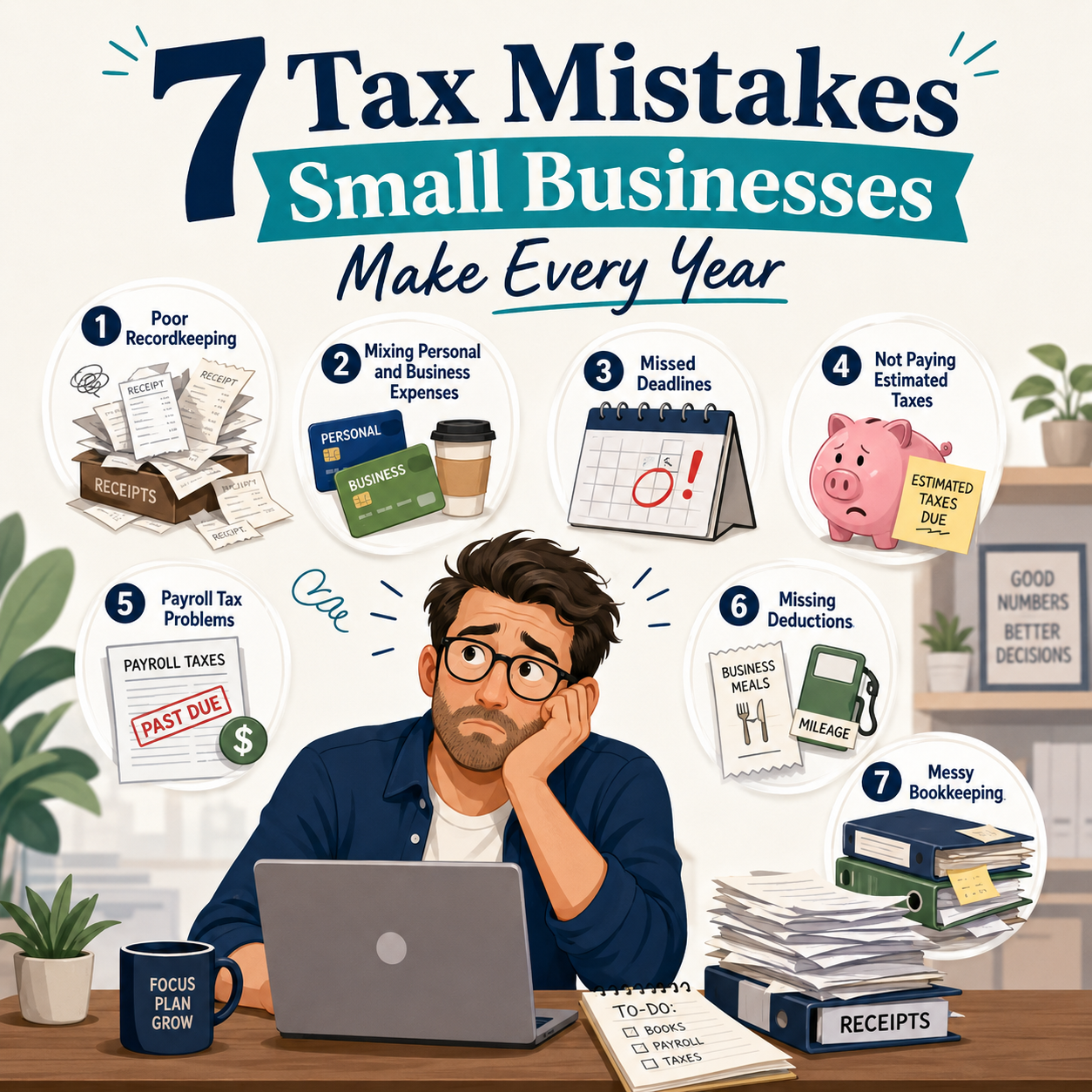
Quick answer: The most common tax mistakes small businesses make are poor recordkeeping, mixing personal and business money, missing income, underpaying estimated taxes, payroll tax problems, missing deadlines, and guessing on deductions. |
Running a small business means wearing a lot of hats. You may handle sales, customers, employees, bills, and taxes – sometimes all in the same day.
Because of that, tax work often gets pushed to the side until tax season. That can lead to stress, missed deductions, penalties, or a tax bill that feels larger than expected.
The good news is that many small business tax mistakes can be avoided. A few simple habits can help keep your records cleaner and your tax planning easier.
At Compton & Company CPAs, we help small businesses with accounting, payroll, and tax services. Our goal is to help you understand your numbers during the year – not just after the year is over.
Good tax returns start with good books. If your records are messy, it is harder to know your true profit. It is also harder to prove your income and expenses if questions come up later.
Good records include bank statements, receipts, invoices, loan papers, payroll reports, mileage logs, and notes about unusual transactions. Your books should show what came in, what went out, and why.
Your business account should not be your personal wallet. When personal and business spending are mixed together, it can be hard to know what the business really earned.
It can also make deductions harder to support. One accidental charge is not the end of the world. But a habit of using the business account for groceries, vacations, or family expenses creates messy books and tax risk.
Business income can come from many places: checks, cash, credit cards, ACH payments, PayPal, Venmo, Square, Stripe, or Form 1099s.
A common mistake is reporting only the income shown on tax forms. But a business must report all income, even if no 1099 arrives. If the IRS receives a form that does not match your return, you may receive a notice.
Many business owners do not have taxes withheld from every payment like an employee does. Sole proprietors, partners, and S corporation shareholders may need to make estimated tax payments during the year.
If you wait until April to think about taxes, you may face a large bill all at once. You may also owe penalties if you did not pay enough during the year.
Payroll taxes are serious because some of that money belongs to employees. Employers withhold taxes from paychecks and must deposit those taxes on time, along with the employer share of payroll taxes.
Mistakes can happen when deposits are late, payroll forms are missed, workers are classified the wrong way, or owner payroll is not planned correctly. This is one area where small errors can become expensive fast.
Some business owners miss deductions they could have taken. Others go too far and claim expenses that are really personal.
A business expense generally needs to be ordinary and necessary for your business. That means it is common for your kind of work and helpful for your business. Good examples may include software, supplies, professional fees, business insurance, mileage, and certain training costs. Personal expenses should stay out of the business books.
Tax season should not be a rescue mission. If your books are not updated until the end of the year, you may forget what certain transactions were for. Receipts may be missing. Planning chances may also be gone.
Clean books help you file a better return. They also help you make better business decisions during the year. You can see if prices need to change, expenses are growing, or cash flow is getting tight.
Many tax problems do not start on the tax return. They start months earlier in the books, payroll, or daily business habits.
That is why it helps to have accounting, payroll, and tax services working together. When your books are cleaner during the year, tax season is usually smoother. When payroll is handled correctly, there is less room for costly compliance mistakes. When your CPA can see your numbers before year-end, there may be more time to plan.
Compton & Company CPAs helps small businesses in Meridian, Mississippi, and throughout Mississippi, Tennessee, and Alabama. We explain the numbers in plain language and help business owners stay organized, compliant, and better prepared.
|
Need help before tax season? Contact Compton & Company CPAs to talk about small business accounting, payroll, and tax services. We handle the math – you handle the business. |
One of the biggest mistakes is waiting until tax time to fix the books. If records are messy all year, the tax return may be missing income, missing deductions, or using numbers that are not reliable.
Keep business and personal money separate, update the books each month, save receipts, track all income, pay payroll taxes on time, and review tax planning before the end of the year.
Many owners do. Sole proprietors, partners, and S corporation shareholders may need estimated tax payments if they expect to owe enough tax for the year. The exact amount depends on the owner and the business.
Yes. Clean bookkeeping helps your CPA prepare a better tax return and spot planning ideas sooner. If the books are behind, tax planning is much harder.
Yes. Compton & Company CPAs provides accounting, payroll, and tax services. That means clients can get bookkeeping support and CPA tax guidance from the same firm.

Quick Answer: It may be time to raise your prices when your costs have gone up, you’re keeping less from each sale, or you’re doing…Read More

What a year of walking (and a still-messy desk) taught me about Darren Hardy’s book “We are what we repeatedly do.” Aristotle said that centuries…Read More

Quick Answer: A small-business worst-case plan should name someone who can make urgent decisions, explain how payroll and critical bills will be handled, identify where…Read More
Comments